We’ve all been there where a link drops into the WhatsApp group for a massive farmhouse featuring a sparkling pool and the bold claim that it comfortably sleeps 30. The photos look like a dream, but the reality check hits the moment you arrive and realize the estate only has three bedrooms. Suddenly, your high-end getaway turns into a logistics nightmare where 12 people take the beds while 18 others are left fighting for patches of floor space. You’re looking at a two-hour queue for three bathrooms, a fleet of cars parked illegally on a narrow village road, and a kitchen that hits its limit after two omelets.
The truth is that 70% of farmhouse disasters are rooted in flawed group-size math. A successful trip means every adult has a designated sleeping spot, mornings flow smoothly with ample washroom access, and your cars are secured safely inside the gates. This guide is your tactical manual to running the numbers like a pro, ensuring the property’s infrastructure matches your headcount.
The Actual Capacity Formula
Double check the ‘Total Guests’ figure on a booking site by applying a simple formula to calculate the Actual Sleeping Capacity – (Bedrooms x 2.5) + (Extra Mattresses x 2)
For example, a property with 5 bedrooms and 6 extra mattresses can realistically handle 25 people, while a 7-bedroom home with 4 mattresses is comfortable for about 22. Treat any listing that claims a 30-person capacity while only showing three bedroom photos as a major red flag, and be wary of vague mentions of sofa-cum-beds, which are notoriously uncomfortable for adults.
To ensure your group stays in the ‘Green Zone’ of luxury, aim for two people per bedroom plus kids on mattresses. This preserves privacy and leaves ample space for luggage. If you push into the ‘Yellow Zone,’ you’re looking at roughly 2.5 people per room, which is manageable but snug. However, avoid the ‘Red Zone’ at all costs, because once you hit three or more adults per bedroom, you’re looking at zero privacy and a total lack of floor space. Always insist on a specific mattress count in your contract to ensure the property’s infrastructure can actually support your headcount.
Group Size #1: Small Groups (6-15 People)
For a close-knit family gathering or small friend group, the goal is intimacy rather than an empty mansion. A 3-4 bedroom setup is the ideal match. By applying the capacity formula (3 bedrooms x 2.5 + 4 mattresses), you get a perfect fit for roughly 13 people. These groups thrive on shared experiences, so prioritize properties featuring open kitchens for collaborative cooking, cozy living rooms for board games, and a lawn of at least 2,000 sq. ft. for a bonfire or badminton. Insist on AC in all bedrooms rather than just a few, at least two attached bathrooms, and secure on-site parking for three cars to ensure the logistics remain as stress-free as the vibe.
Group Size #2: Medium Groups (16-30 People)
For medium-sized groups perfect for corporate offsites or milestone birthdays, the 5-7 bedroom farmhouse is your target, providing a realistic capacity for 24 people when utilizing six bedrooms and six extra mattresses. To keep the morning routine from collapsing, you need a minimum of 4,000 sq. ft. of lawn space for group activities. With these amenities, also confirm that there are at least four bathrooms equipped with high-capacity geysers to ensure everyone gets a warm shower without a two-hour wait.
Group Size #3: Large Groups (31-50 People)
At this scale, you are no longer just booking a house. You are managing an event that requires a premium experience for 35–50 people. You need a powerhouse property, ideally 10+ bedrooms and a sprawling 8,000+ sq. ft. lawn, providing the physical breathing room that defines a luxury retreat. Be extremely wary of hosts who claim they can adjust 10 extra guests without dedicated rooms, as this almost always translates to people sleeping on living room floors with zero privacy. You can also ask for a layout that is explicitly designed for high-capacity events, including secure on-site parking for at least 10–12 vehicles to keep your guests’ cars off vulnerable village roads.
Parking Reality (Car Chaos Prevention)
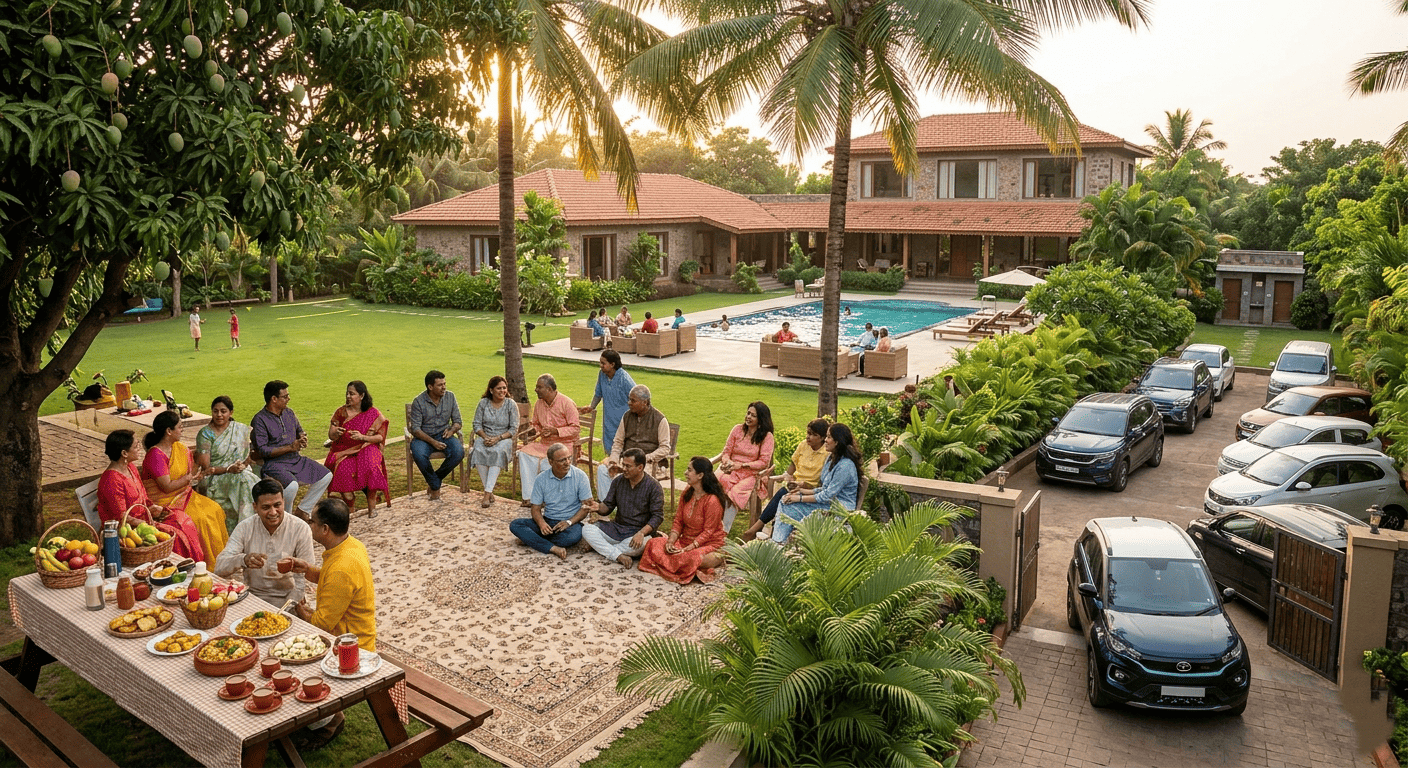
If you have 30 people, you likely have 6–8 cars. If the farmhouse only has space for 3 cars inside the gate, you have a security problem.
1 Car Per 4-5 People Rule
- 15 people = 3 cars inside.
- 40 people = 8–10 cars inside.
Never agree to park on the main road. Farmhouses are often in remote or village areas where unattended cars are targets. Always ensure the compound wall is tall and the gate is lockable.
Kitchen Capacity by Group Size
Small (15 people)
You can get away with a standard home kitchen. Ensure there are 2 fridges (one for food, one for drinks).
Medium (25 people)
You need a 6-burner commercial stove and a large prep counter. If the kitchen is too small, your meals will be delayed by hours.
Large (40+ people)
At this size, look for a property with a dedicated catering kitchen (separate from the main house) or a tie-up with a local caterer. You need a pot-wash sink that is separate from the food prep area.
The Perfect Farmhouse Capacity Matrix
| Group Size | Bedrooms | Extra Mattresses | Washrooms | Parking | Lawn Space |
| 6-15 | 3-4 | 2-6 | 2-3 | 3 cars | 2,000 sq ft |
| 16-30 | 5-7 | 6-10 | 4-6 | 6 cars | 4,000 sq ft |
| 31-50 | 8-12 | 10-16 | 6-10 | 10 cars | 8,000 sq ft |
Conclusion
Choosing the wrong farmhouse capacity turns a celebration into a series of no sleep and privacy, bathroom queues, and parking nightmares. However, when you apply the right math, you ensure smooth mornings, comfortable nights, and most importantly, happy memories where every guest feels like a priority rather than an afterthought. Your gathering is a special occasion; it deserves the mathematical precision required to make it seamless. By prioritizing verified bedroom counts, non-negotiable washroom ratios, and secure on-site parking, you eliminate the risk of capacity surprises. Book your perfect farmhouse stay today and ensure your only focus is the celebration itself, not the logistics of the floor space.